The Pollinator Ontology: Building a shared language for pollinators
Pollinators are not only objects of study in biological research but also play an essential role in agronomy, ecology and the economy. That’s why pollinator data is scattered across different domains and uses inconsistent terminology, formats and languages. This makes it difficult for people to combine the information and also hinders machine reading. Can these barriers be overcome and the terminology harmonised?
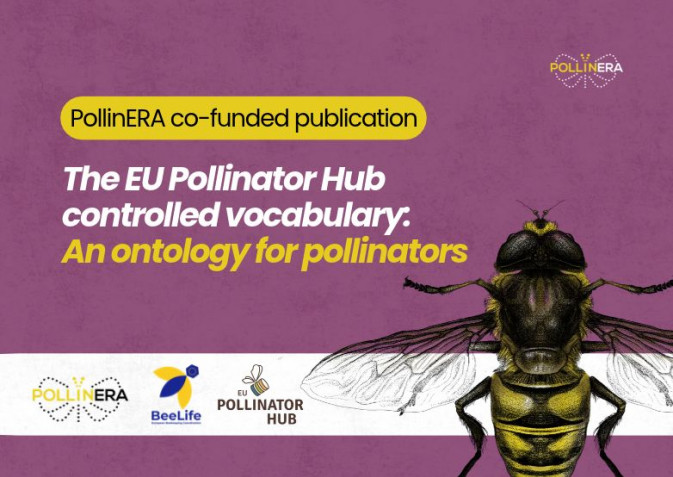
A recently published PollinERA co-funded publication in PLOS One journal introduces the Pollinator Ontology (PolOn), a subset of the EU Pollinator Hub Controlled Vocabulary that aims to gradually solve this problem. Pollinator Ontology was developed within the framework of the EU Pollinator Hub, an initiative sponsored by the European Food Safety Authority (EFSA). It aims to improve the standardisation and internationalisation of pollinator data across all domains relevant to describing interactions between pollinators and their biotic and abiotic environment, particularly with humans.
The Pollinator Ontology is the first ontology to incorporate a very large set of terms (currently circa 500) related to beekeeping. It defines more than 8.000 of pollinator-related concepts and the relationships among them. Moreover, it aims to overcome linguistic fragmentation across countries by including 12,655 translations in 88 languages. The five most common languages are English (24,4% of all translations), German (15,0%), Dutch (6,5%), French (6,3%) and Italian (6,3%). Translations also appear in Portuguese, Spanish, Romanian, Swedish, Danish and Norwegian. The Pollinator Ontology also incorporates other existing ontologies with related data.
Developing the Pollinator Ontology is a major step toward using a common, structured vocabulary and standardised metadata to collect, share, and analyse pollinator data across disciplines. The ontology's future development would be community-driven, with ongoing refinement and expansion of its terminology. It would also be aligned with emerging data standards to support broader adoption in research, policy, and operational contexts.
Read the full publication here.